|
K. von F--1914--Arras-Bouquoi
(by Marsden Hartley) (1940) "by the haste of a cruel stop, ill-placed" Robert Crashaw Man in perfect bloom of sixfoot splendourlusty manhood time--all made of youthful fire and simplest desire, voiceless now these many years-- what music in the voice that was, beyond all calumny of tears. What makes it seem as if you never went away-- what gentle gleam from out the perfidy of wars gives hint of immortality? In dream I saw you once all made of living fire-- clothed in lightning's wondrousness there to cherish, there to bless-- the light flew up my willing side and filled me with fraternal pride, all made of pristine fire you were, symbol of your natural attire; Yourself the moment that I saw and took into my heart is still an image that I worship-- not death but love inspire to keep this everlasting fellowship. (p. 219 in Collected Poems) |
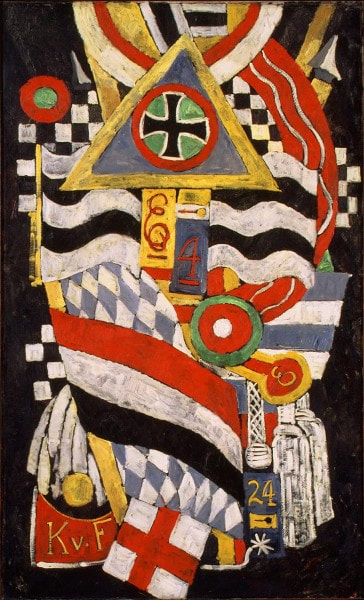
Marsden Hartley, Portrait of a German Officer. 1914. The Metropolitan Museum of Art, New York.
|
Discussion points / questions / activities
(Edyta Frelik and Jerzy Kutnik, Maria Curie-Sklodowska University, Lublin: Marsden Hartley’s Portrait of a German Officer: (Be)Speaking the Unutterable)
(https://warinthevisualarts.wordpress.com/abstracts/the-soldiers-body/)
- In the spring of 1913 American painter Marsden Hartley arrived in Berlin, where the power and uniqueness of his brilliant compositions gained him instant recognition and the respect of the Berlin art world. But his romantic involvement with a young German officer, Karl von Freyburg, turned into an excruciating drama with the latter’s death soon after the outbreak of World War I. Even when satisfied with his work as a painter, Hartley also wanted to be recognized as a writer, regarding painting and writing as complementary and reciprocally conjoined. In 1914 he painted Portrait of a German Officer and then, some years later, wrote a poem, “K. von F. – 1914 – Arras-Bouquoi,” which addressed precisely what he had already depicted in his most acclaimed painting. A composition made up of decorative elements of a German officer’s uniform, Portrait of a German Officer was intended as an homage to von Freyburg. Eschewing traditional expectations about elegiac portraiture and conveying a feeling of bereavement, the painting is one of the most outstanding examples in American art of compositional precision and balance on the one hand and formal exuberance and boldness on the other. There is a glaring difference between the poem and the painting: Hartley’s attempt to relieve, and re-live, in words his persistent grief by refreshing the memory of his German lover and his own dream about him strikes one as a dissonant echo of his original tribute.
(Edyta Frelik and Jerzy Kutnik, Maria Curie-Sklodowska University, Lublin: Marsden Hartley’s Portrait of a German Officer: (Be)Speaking the Unutterable)
(https://warinthevisualarts.wordpress.com/abstracts/the-soldiers-body/)
- This monumental painting is the centerpiece of a series that evokes the dynamism, pageantry, and danger of life in Berlin during World War I. The painting’s collagelike appearance, dramatic color, and emotional brushwork attest to Hartley’s skillful synthesis of Cubism and German Expressionism. Hartley’s composition is an abstract portrait of Karl von Freyburg, a Prussian lieutenant whom the artist loved (and was perhaps intimate with) and who died in the war. Von Freyburg is portrayed symbolically with the initials, "K.v.F."; his regiment number, 4; his age at death, 24; the Iron Cross that he received posthumously; and the blue and white flag of his home in Bavaria.
- Lisa Messinger (transcribed from the MET audio tour): Hartley is so taken with the German military. And it's not really a political statement that he's making; he loved these handsome men and their beautiful uniforms, and the pageantry, and the regalia, and all these medals and tassels and feathers and helmets, and what he does is abstract them into these amazing designs. It's the largest piece of the series, and is quite powerful. The fact that Hartley organizes it in a very vertical format, even though it's not a literal figure, means that we read it as a figure. There's sort of a head-like shape at the top, and we also get a sense of the torso. This painting was really Hartley's great achievement.
- In what way is this painting a portrait? In what way is it not a portrait?
- How do you think people reacted to this painting in 1914? How might different sides in the war effort (WWI) approach this painting differently / read different things into it?
- Notice how Hartley doesn't reveal his sexuality in the poem. However, in his word choice / imagery / connotations, he makes it fairly clear, while still 'saving face' in a time period / art world that may not have fully understood or accepted him. For instance, the word "fellowship" at the end of the poem leaves his sexual preference open to interpretation.
- Do you think the poem changed the meaning of the painting / how the painting is received? (The poem was written 30 years after the painting).
